Kubota European Engine Business Unit will make its debut appearance at this year’s INTERFORST 2026 exhibition, taking place from 15th to 18th October 2026 at the Trade Fair Center Messe München, Germany.
Located within the new DLG SYSTEMS & COMPONENTS area, in Hall B6, Stand 239, Kubota will showcase a range of innovative power solutions, highlighting more than 100 years of experience in engine development and manufacturing.
As one of the leading international exhibitions for forestry and forest technology, INTERFORST provides Kubota with a perfect opportunity to introduce its advanced engine technologies to Original Equipment Manufacturers (OEM) and professional operators from across the forestry sector. The company will demonstrate how advanced technology, high performance and greater efficiency can support the ever-increasing demands, and cost pressures facing the forestry and industrial markets.
Kubota engines are already today found in a vast range of forestry and specialised equipment around the world, supporting operators with dependable and efficient power in demanding environments. They power many machine types such as Skid Steer Loaders, Woodchippers and Light Forwarders, where typically compact dimensions, high efficiency and dependable performance are expected.
Kubota continuously works in collaboration with its OEM partners to further develop engine solutions that meet the specific requirements of modern forestry and off-highway applications.
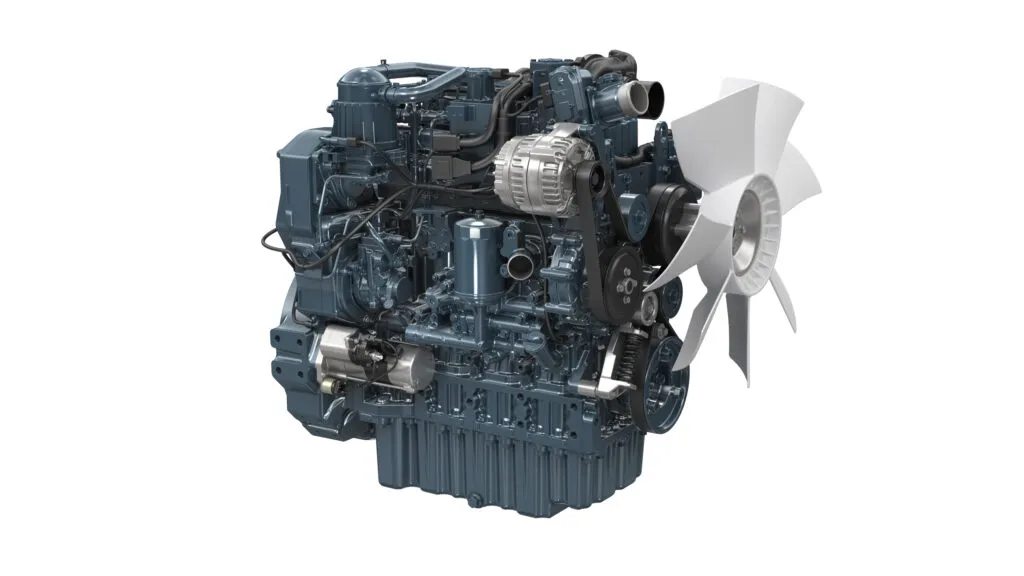
The highly efficient Kubota 09 Series V5009 marked the company’s first diesel engine to deliver more than 200 HP and was developed to meet the higher power requirements of industrial machinery.
The V5009 delivers up to 157.3 kW (210.9 HP) at 2,200 rpm while complying with EPA/CARB Tier 4 and EU Stage V emissions standards.
High fuel efficiency is achieved through Kubota’s optimized combustion system within a compact four-cylinder design, helping to reduce fuel consumption and lower the total cost of ownership. The engine also offers high power density, making it suitable for applications where installation space is limited.
For ease of maintenance, the V5009 engine oil and fuel filters, together with the oil gauge, are positioned on the same side of the engine for easier and more efficient servicing.
To meet stringent emissions regulations, the engine is equipped with a Diesel Oxidation Catalyst (DOC), Diesel Particulate Filter (DPF), and Selective Catalytic Reduction (SCR). Like all Kubota diesel engines, the 09 Series is compatible with HVO fuel.
“INTERFORST provides an excellent opportunity for us to present our engine technologies to the forestry industry for the first time,” said Daniel Grant, Manager Marketing Intelligence for Kubota Business Unit Engine Europe.
“With more than a century of engine expertise, Kubota continues to develop technologies that help customers improve productivity, reduce operating costs, and meet increasingly demanding environmental standards. We are excited to make our INTERFORST debut and look forward to engaging with customers and partners from across the forestry sector.”
The latest addition to the Kubota engine portfolio on display at INTERFORST 2026 is the D902-K, Kubota’s first electronically controlled diesel engine below 19 kW, featuring the company’s highly advanced and common rail system developed exclusively for small engines, TVCR.
Characteristics of the new three-cylinder, vertical, water-cooled, four-cycle diesel engine include smokeless operation, less carbon emissions due to low fuel consumption, high performance at high altitude and stable support for machine operations. The engine meets regional emissions standards EPA Tier 4 and EU Stage V and is approved for use of HVO fuel.
As the engine is electronically controlled, the D902-K can communicate via Controller Area Network (CAN), which means engine operating data needed for remote monitoring of performance can be acquired.
The common rail D902-K has a displacement of 0.898 L. Output (Gross kW/rpm) is 18.5/3600; 16.5/3200 and 13.4/2600. Torque (Gross Nm/rpm) is 56.1/2600, 56.1/2400 and 55.2/2200. Dry weight is 72 kg.
Also on display will be the V1505-CR-T, a compact four-cylinder diesel engine designed for modern industrial equipment.
The V1505-CR-T delivers 33.0 kW while fully complying with EPA Tier 4 and EU Stage V emissions standards.
Equipped with DPF technology, the engine features automatic regeneration at low engine speeds, helping to reduce downtime and increase productivity. Long maintenance intervals, compact dimensions, and flexible installation options make the V1505-CR-T an ideal solution for a wide range of industrial and off-highway applications.
Visitors to INTERFORST 2026 are invited to visit the Kubota Engine team in Hall B6, Stand 239, to discover how Kubota’s latest engine technologies support the next generation of forestry and industrial machinery.